
Bike Drivetrain Design
Updated: Dec 28, 2025
This is a developing blog post, and I will update it as I get further along in the building process.
718 Outdoors is a 1-person operation that has remained small, local and independent by design. If this resonates with you, your support is welcome and greatly appreciated! If not, that's cool too.
I am redesigning my drivetrain this offseason. I am running what is referred to a 3x10 drivetrain (3 chainrings on the front derailleur and 10 cogs on the rear cassette), shifted with full friction bar-end shifters.
The big picture here is that I have a drivetrain with 8,000+ miles on it that needs to be replaced this offseason. The changes I am looking to make are the shifters (more robust and reliable SunTour vintage bar-end shifters), a crank with a square taper bottom bracket (more weather and dirt protection in my opinion), and moving to SRAM components (personal preference and experience).
The set-up I ran with for 2024-2025 was:
Existing 2024/2025 Drivetrain:
Crank: Shimano FC-MT500-3 Crankset, 175mm, 10-Speed, 40/30/22t. Fine and functional, however I have chipped a few teeth in the largest ring which causes me to not be able to shift into my big ring.
Bottom Bracket: Shimano BB-RS501 Hollowtech II English Bottom Bracket. I went through 2 of these is 2025 alone. I just feel that the outboard bearings of the Hollowtech system invite more dirt and water/weather inside.
Front Derailleur: Shimano Deore FD-T6000 10-Speed Triple Top-Swing Dual Pull
Rear Derailleur: Shimano Deore RD-T6000-SGS Rear Derailleur - 10 Speed, Long Cage
Chain: Shimano 10 Speed. This chain was installed using a pin, and I wanted to move to a Masterlink system to make things easier to repair. This chain was very stretched out over 8,000+ miles, as any chain would be.
Cassette: Shimano CS-HG500 Cassette - 10-Speed, 11-32t. No real issues here, but things have gotten worn.
Shifters: microSHIFT Bar End Shifter Set, 10-Speed Mountain, Double/Triple
2026 Drivetrain (Proposal):
Crank: Velo Orange Grand Cru 110 Fluted Triple Crankset, 170mm, 48/34/24t. The crank, with the expanded new cassette (see below) will essentially widen my spectrum of gearing, from easiest to hardest. Considering the riding that I do, this will be great
Bottom Bracket: Velo Orange English Threaded Bottom Bracket 124mm. I feel that square taper bottom brackets let in less water and dirt than Hollowtech ones. The downside of a square taper bottom bracket is weight (don't care), diameter of bearings, and overall crank rigidness.
Front Derailleur: Shimano Deore FD-T6000 10-Speed Triple Top-Swing Dual Pull (not replacing)
Rear Derailleur: SRAM GX Rear Derailleur - 10 Speed, Long Cage. This rear derailleur has a Chain Wrap Capacity of 47. More about this below.
Chain: SRAM PC-1051 Chain - 10-Speed, 144 Links. Thus chain is installed with a Masterlink, which I find better for trailside repairs
Cassette: SRAM PG-1030 Cassette - 10 Speed, 11-36t. Since my new crank has a lowest ring of 24t (previous crank was at 22t) I am looking to bump up the biggest ring on my cassette to 36t (from 32t). This gets me outside of the Chain Wrap Capacity of the rear derailer (47, see diagram below), but I think it should be within the tolerance window of it working.
Shifters: SunRace (vintage) Bar-End Shifters. While the bike industry pushes everyone to the electronic shifting of the future, I'm going back in time to the 1970s with these timeless and durable shifters.
Chain Wrap Capacity
The biggest criteria for design a 3x (three front chainrings on the crank) is to understand what is called Chain Wrap Capacity. This is a value that represents the rear derailleur ability to handle the chain in all of its positions on the 3 front chainrings and the (in this case) 10 rear cogs on the rear cassette.
"Chain Wrap Capacity refers to the amount of chain slack a (rear) derailleur's cage can absorb and keep under tension. It's calculated as the sum of the differences in teeth between your largest and smallest front chainrings and your largest and smallest rear cogs" (online definition).
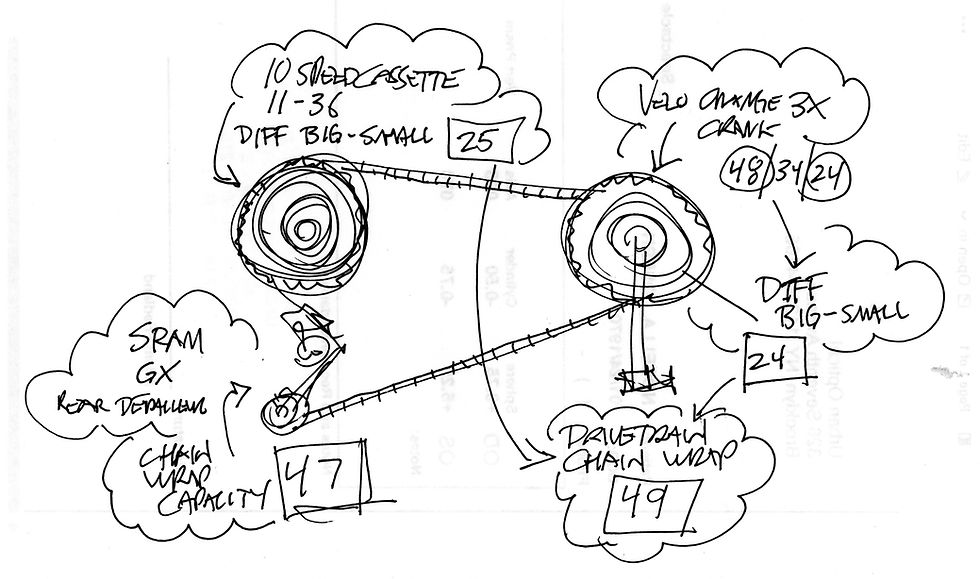
Ultimately, the Chain Wrap Capacity of the new rear derailleur is "47", which is 2 more than the "49" which this setup requires. In the research I've done, I think that being 2 over is going to be fine (the bike industry regularly specs things down to cover their a$$).

Front Derailleur Issues
A front derailleur also has a capacity rating, which is the difference between the crank's biggest and smallest ring. My existing front derailleur, which I am keeping, is rated to 22t. The new drivetrain design is 24t (48t-24t). This is a minor issue, and my research indicated this wont be a big deal.
In addition, front derailleurs have a rating for the largest chainring than can handle, my my existing front derailleur is right on the money at 48t
Bike Drivetrain Design Conclusion
I will begin building late December/early January, with the idea of testing soon thereafter. My only slight concern is the Chain Wrap Capacity issues on the front and rear derailleurs, as I can't have any monkeying around in terms of shifting. I will update below as I progress.
Final Note:
For better or worse, I do not use AI to create my posts. This is all me, with my misspelling, poor grammar and tangential thoughts. I didn't get into this line of work to hand over my thoughts, expertise and experience to AI to spit out blog posts.


Comments